Summary:
You’ve done some research. You’ve seen the brand names — Beam, NuTone, Vacuflo, DrainVac — and you still have no idea what separates one from another, or what any of this is going to cost you. Every website either lists brands without explaining them or hides pricing behind a “call us” wall.
That’s frustrating, and it’s exactly why we put this together. We’re going to walk you through the major central vacuum brands, what tier they actually represent, what you can expect to pay, and what the inlet types in your home mean. No runaround. Just the information you need to make a smart decision.
Central Vacuum Brands Explained: Premium, Mid-Range, and Builder-Grade
The brand name on a central vacuum unit tells you less than you’d think. Beam makes entry-level systems and premium systems. NuTone covers a wide range too. What actually matters is the tier — the performance level within that brand — and most homeowners never learn to look for it.
There are three tiers worth understanding: premium, mid-range, and builder-grade. Each one has a different motor type, filtration approach, warranty, and expected lifespan. Knowing which tier you’re looking at — or which tier is already sitting in your basement — changes everything about how you evaluate your options.

What Makes a Central Vacuum System Premium — and Is It Worth It?
Premium-tier systems are built to last and built to perform. DrainVac is the clearest example — manufactured in North America using European motors, with a lifetime motor warranty. Beam’s upper-tier models, like the Serenity 398, deliver 700 air watts and cover homes up to 7,500 square feet. These aren’t systems you replace in a decade. They’re systems that outlast renovations, ownership changes, and whatever your pets can throw at them.
What separates premium systems isn’t just raw power. It’s the motor construction, the filtration technology, and the warranty backing. DrainVac’s lifetime motor warranty is genuinely rare in this industry. Beam’s upper models come with a 7-year or 750-hour product warranty. When you’re investing $1,500 to $3,500 or more installed, that warranty coverage matters.
Premium systems also tend to use two-stage motors and advanced filtration — either cyclonic separation or sealed HEPA filtration that captures over 99% of allergens. For Nassau County homeowners dealing with Long Island’s dual allergy seasons — spring pollen and fall ragweed — that distinction is real and noticeable. The EPA has specifically cited central vacuum systems for their ability to reduce dust mites, pollens, and animal dander, but sealed HEPA filtration takes that further by removing those particles from the living space entirely rather than recirculating them.
For a larger home in Old Westbury or a renovated colonial in Garden City, a premium system is usually the right call. For a 1,400-square-foot Cape Cod in Massapequa, it may be more than you need — and a well-installed mid-range system will outperform an oversized premium unit that wasn’t sized correctly for the space.
Mid-Range and Builder-Grade: What NuTone, Beam Entry Models, and Inherited Systems Actually Represent
Mid-range systems are where most Nassau County homeowners land — and for good reason. NuTone’s Pure Power series delivers 550 to 700 air watts and covers homes up to 10,000 square feet, with sealed HEPA filtration and a system lifespan of 15 to 20 years. NuTone has been in the home products business since 1936, and their mid-range line is genuinely solid for most residential applications. It’s not a compromise — it’s a right-sized choice for the majority of Long Island homes.
Beam’s mid-tier models, like the Alliance 650SB at 600 air watts with an LED control interface, fall into similar territory. Beam has been manufacturing central vacuums since 1957, and their mid-range line reflects decades of refinement. Parts are widely available, authorized service is accessible, and the systems hold up.
Builder-grade is where things get complicated. If you bought a home in Nassau County — particularly anything built in the 1980s or 1990s in communities like Levittown, Hicksville, or Massapequa Park — there’s a real chance you have a central vacuum rough-in already in your walls. Maybe the power unit is dead. Maybe there’s no power unit at all, just piping and inlet valves. Maybe you don’t even know what brand was installed.
This is one of the most common situations we see, and it’s one that almost no one in this industry addresses honestly. Builder-grade systems were frequently undersized, underpowered, and installed with minimal inlet coverage. A single inlet valve should cover no more than 600 to 900 square feet — many builder installs ignored that entirely. The good news is that if the piping is intact, activating or upgrading an existing rough-in with a new power unit can cost significantly less than a full installation from scratch. The first step is knowing what you have — which is exactly what a free consultation is designed to figure out.
One more thing worth knowing: if you can’t find a brand name anywhere online, there’s a strong chance it’s a private-label unit — a generic system sold under a house brand with limited or no parts availability. If that’s what’s in your basement, replacement is almost always the smarter move than repair.
In Home Vacuum System Cost: What Nassau County Homeowners Actually Pay
Here’s the part everyone wants and no one publishes. National averages from sources like HomeAdvisor put the typical central vacuum installation between $1,094 and $2,194, with a midpoint around $1,583. Thumbtack’s data shows a wider range — $1,200 to $4,200 installed — while HomeGuide puts the installed range at $800 to $3,500, with equipment alone running $400 to $2,000.
Those ranges are real, and the spread reflects genuine differences in home size, system tier, and installation complexity. A retrofit installation in an occupied home — running piping through finished walls in a 1960s split-level in Hicksville — costs more than a rough-in during new construction. A premium DrainVac system for a larger home in Syosset costs more than a mid-range NuTone in a Levittown ranch. That’s not evasion — it’s just how it works.
Central Vacuum Prices by System Tier: What You're Actually Getting at Each Level
At the lower end of the installed cost range — roughly $800 to $1,400 — you’re typically looking at a mid-range system in a smaller home with a straightforward installation. The unit itself might be a NuTone entry-level or a Beam Platinum SC325. The system will work, and it will last. But if your home is larger than 2,000 square feet or you have significant allergen concerns, this tier may underperform over time.
In the $1,500 to $2,500 range, you’re into solid mid-range territory — NuTone Pure Power, Beam Alliance — with proper inlet coverage, correct low-voltage wiring at each inlet, and installation by someone who knows how to size the system to your home. This is where most Nassau County homeowners end up, and for most Nassau County homes, it’s the right outcome.
Above $2,500 and into the $3,500-plus range, you’re looking at premium systems — DrainVac, upper-tier Beam — in larger homes or installations with added complexity. The Hide-A-Hose retractable in-wall hose system also adds to the installed cost, but for homeowners in smaller Cape Cods or split-levels where storage is tight, the trade-off is often worth it. The hose retracts fully into the wall when you’re done — no 30-foot hose to coil and store.
Repair costs, for context, average around $322 nationally, with a range of $129 to $561. Labor typically runs $15 to $60 per hour, and most service calls carry a minimum fee of $50 to $250. If your existing system is aging but the piping is sound, repair or power unit replacement is often a fraction of a full installation.
The honest answer to “what will this cost me?” is: it depends on your home, your system tier, and your installation complexity. A system installed correctly today — properly sized, properly wired, with the right number of inlet valves for your square footage — will likely still be running 20 years from now. That changes the math considerably compared to replacing a $400 portable vacuum every five to eight years.
Central Vac Baseboard Inlet and Floor Mounted Central Vacuum Inlet: What Type Do You Have?
If you’ve moved into a home with an existing central vacuum rough-in, or if you’re planning a new installation, understanding inlet types helps you know what you’re looking at — and what your options are.
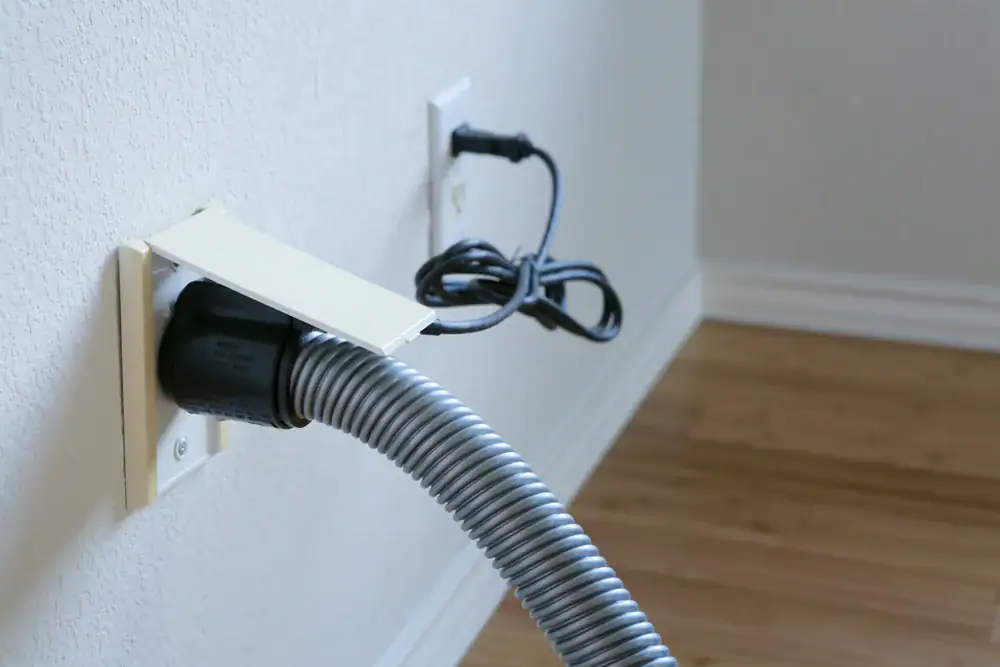
The most common type is the standard wall inlet: a valve mounted in the wall at about hip height, into which you plug the hose to activate the system. These are the baseline of any central vacuum installation and are typically spaced so each one covers 600 to 900 square feet of living space. A 90-degree elbow behind the inlet prevents long objects from entering the piping and causing blockages — a detail that separates a quality installation from a rushed one.
A central vac baseboard inlet — sometimes called a VacPan or toe-kick inlet — is a different animal. It’s mounted at floor level, typically in a kitchen, utility room, or entryway, and it’s activated by sweeping debris toward it with a broom or by pressing a toe-kick lever. You sweep, it disappears. For Nassau County homeowners who cook seriously or have pets tracking debris through the kitchen, a baseboard inlet is one of those additions that sounds minor until you have it. They’re available in white, almond, and black to match your trim, and some models include LED lighting.
A floor mounted central vacuum inlet is used when wall installation isn’t possible — in slab-floor construction, for example, or in areas where the wall cavities aren’t accessible. These inlets sit flush in the floor and require a specific installation: approximately two inches from the wall, away from high-traffic paths, with a metal construction for durability. The floor opening is typically 2.5 by 4.375 inches. They’re less common than wall or baseboard inlets, but in the right situation they’re the only practical option.
If you’re not sure what type of inlets you have — or whether the inlets in your home are properly placed to cover your square footage — that’s exactly the kind of thing a walkthrough can clarify before any money changes hands.
Choosing the Right Central Vacuum Brand for Your Nassau County Home
The brand name matters. The tier matters more. And the installation matters most of all. A premium DrainVac installed with the wrong inlet spacing will underperform a mid-range NuTone installed correctly every time. That’s not a knock on any brand — it’s just the reality of how these systems work.
For Nassau County homeowners — whether you’re retrofitting a post-war ranch in Levittown, activating a rough-in left by a previous owner in Massapequa, or building new in Syosset — the right system is the one that’s sized for your home, installed by someone who knows what they’re doing, and backed by a brand with real parts availability and warranty support.
If you want a straight answer on what makes sense for your specific home, DuraVac Central Vacuum Specialists, Inc. offers a free consultation. No pressure, no runaround — just an honest look at what you have, what you need, and what it will actually cost.