Summary:
You’ve probably looked at your portable vacuum, thought “there has to be something better than this,” and then talked yourself out of spending $2,000 on a built-in system. That’s a completely reasonable place to be. The question isn’t whether central vacuums sound good on paper — they do. The question is whether they’re actually worth it for your home, your family, and your budget. For Nassau County homeowners specifically, the answer involves a few local factors that national comparison articles tend to skip entirely. Let’s get into it.
Whole House Vacuum System Installation: What You're Actually Getting
A central vacuum system replaces your portable vacuum with a fixed power unit — typically installed in a basement, utility room, or garage — connected to inlet valves throughout your home via a network of pipes running through the walls. You plug a lightweight hose into any inlet and vacuum normally. The motor never comes into the room with you.
That last part matters more than it sounds. Because the motor is housed separately, it can be significantly larger and more powerful than anything you’d carry around. The result is deeper cleaning, less recirculated dust, and a noticeably quieter experience in the room you’re actually cleaning.
Nassau County homes — especially the Cape Cods, split-levels, and colonials that make up most of the county’s post-war housing stock — are well-suited to retrofit installation. This means you don’t need to be building new to take advantage of a central vacuum system. We’ve successfully installed systems in hundreds of Long Island homes just like yours.
Is Central Vacuum Worth It If You Already Have a Good Portable Vacuum?
This is the most honest version of the question, and it deserves a direct answer. If your current vacuum is doing the job and you have no allergy concerns, no pets, and no frustration with the process, a central vacuum system is a nice upgrade but probably not urgent.
For most Nassau County households, though, that’s not the situation. Think about what a typical Long Island home actually looks like in practice: multiple floors, a dog or two, kids tracking in whatever they picked up at school, and a cleaning routine that has to happen around work calls, nap schedules, and general household noise.
A portable vacuum — even a good one — requires you to haul the unit up and down stairs, deal with the noise at close range, and accept that the fine particles it stirs up get pushed back into the air you’re breathing. Central vacuum systems address all three of those friction points at once.
The motor stays put, so there’s no hauling. The noise stays in the utility space, not the living room. And because the exhaust vents outside the home entirely rather than filtering and recirculating it, the air quality difference is real — not theoretical.
Studies have found that homes with central vacuum systems have 35% fewer airborne allergens than homes using portable vacuums. For households with allergy sufferers, that number is hard to ignore, particularly on Long Island where pollen seasons run nearly year-round: tree pollen in spring, grass through summer, and ragweed well into October.
The “I loved my Dyson, but…” arc shows up consistently in what our customers tell us. They weren’t unhappy with their portable vacuum — until they experienced something that actually worked better. Once that comparison exists, it’s hard to go back.
What Does Whole House Vacuum Installation Actually Look Like in an Existing Nassau County Home?
Retrofit anxiety is real, and it’s one of the most common reasons homeowners put this decision off. The concern makes sense: you’ve just finished renovating your kitchen, or you’ve got hardwood floors you spent real money on, and the last thing you want is a contractor opening up your walls and leaving a mess behind.
The good news is that professional central vacuum installation in an existing home doesn’t require the kind of demolition people imagine. Pipes are routed through attics, basements, and accessible wall cavities — the same paths that electricians and HVAC technicians use in retrofit work.
In most Nassau County homes, the combination of a basement and attic access makes routing straightforward. Inlet valves are typically installed at baseboard level in key rooms, and the visible hardware is minimal. We’ve had customers come to us mid-renovation specifically because they wanted to coordinate the installation with work already underway — and others who were nervous about disrupting a home they’d just finished improving.
In both cases, the result was the same: the home looked exactly as it did before, with the addition of a few low-profile inlet valves and a power unit in the utility space. One customer told us directly: “We had a concern if the central vac installation would mess up the work that we had done. We were informed that everything would be exactly the same — and it was.”
For most homes, installation requires 3 to 6 inlet valves for complete coverage, depending on square footage and layout. The power unit is sized to match the home. Everything is tested before the job is considered done. It’s a half-day to full-day process in most cases — not a week-long project.
The Real Cost of a Central Vacuum System for Nassau County Homeowners
Installation for most Long Island homes runs between $1,500 and $3,000, depending on size and the features you choose. That upfront number is what tends to give people pause, especially when a decent portable vacuum costs a fraction of that.
But the upfront comparison isn’t the right comparison. Central vacuum systems routinely last 20 years or more with minimal maintenance. A quality portable vacuum, used regularly, typically needs replacing every three to five years.
Do that math over two decades and the picture shifts considerably. You’re not choosing between a $2,500 system and a $500 vacuum — you’re choosing between a $2,500 system and replacing that $500 vacuum four to six times over the life of your home.
Does a Central Vacuum System Add Value to a Nassau County Home?
This is where the conversation gets interesting for Nassau County specifically. Central vacuum systems are recognized as a value-adding home feature — not just a convenience upgrade. Research consistently puts the added resale value at around 2.5% of the home’s price.
Nassau County’s median home price sits around $716,000. Apply that 2.5% figure and you’re looking at roughly $17,900 in added home value. That’s not a guarantee, and real estate markets are always variable, but it does reframe the investment in a meaningful way.
You’re not just buying a better vacuum — you’re making a documented home improvement that buyers recognize and that appraisers account for. For homeowners in communities like Garden City, Great Neck, Rockville Centre, or Manhasset — where home values run well above the county median — that number climbs higher.
For anyone thinking about selling in the next five to ten years, it’s worth factoring into the decision alongside the day-to-day quality-of-life benefits. Central vacuum systems also qualify for LEED and NAHB green building points, which matters for homeowners pursuing certifications or who care about indoor environmental quality as a documented feature of their home.
What About the Hose? The Objection That Comes Up Every Time
Here’s the most common pushback we hear: “You still have to drag the hose around, so what’s the point?” It’s a fair question, and for traditional central vacuum setups, it’s a real consideration. Standard hoses run 30 to 35 feet, which covers most rooms from a single inlet — but you’re still carrying the hose from room to room and storing it somewhere.
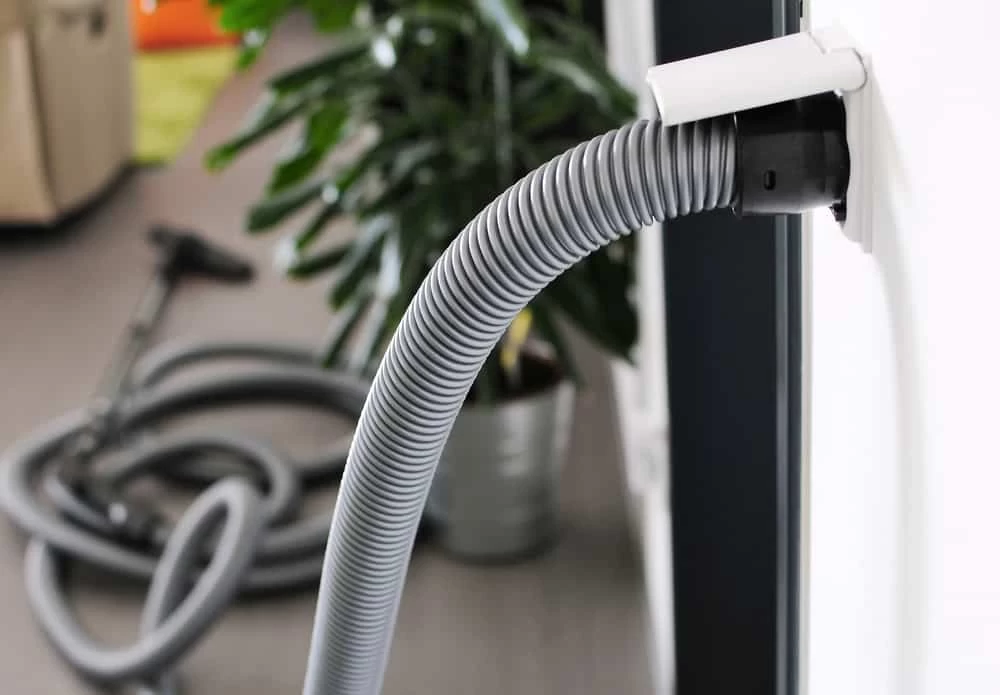
That’s exactly why we specialize in the Hide-A-Hose system. It’s an in-wall retractable hose that lives inside the wall cavity and pulls out when you need it. When you’re done, it retracts automatically. There’s no hose to coil, store, trip over, or haul between floors.
You open the inlet valve, pull out what you need, vacuum, and let go. That’s the entire process. For Nassau County homeowners who were almost sold on a central vacuum but couldn’t get past the hose logistics, the Hide-A-Hose tends to be the thing that closes the gap.
It’s not a gimmick — it’s a practical solution to the one legitimate inconvenience of traditional central vacuum systems. And it makes the whole experience noticeably cleaner and easier, which matters when you’re deciding whether a system will actually get used every week or sit mostly ignored.
The combination of a properly sized power unit, well-placed inlets, and a retractable hose system is what separates a central vacuum that genuinely transforms your cleaning routine from one that ends up being more trouble than it’s worth. Getting the design right from the start is the difference — and that’s where working with someone who specializes in this and has done it for over 50 years makes a real difference.
So, Are Central Vacuums Worth It? Here's the Honest Answer
For most Nassau County homeowners — especially those with pets, children, allergy concerns, or multi-story homes — yes, a central vacuum system is worth it. Not because of any single feature, but because of what the whole package actually delivers: cleaner air, less physical effort, quieter operation, a longer useful life than portable vacuums, and measurable added value to your home.
The hesitation is understandable. It’s a real investment, and it’s permanent in a way that buying a vacuum from a big-box store isn’t. But the homeowners who’ve made the switch consistently say the same thing: once you have it, you can’t imagine going back.
If you’re ready to stop wondering and start getting real answers for your specific home, we’re here to help. We offer free consultations, and we’ll give you a straight picture of what installation would look like, what it would cost, and whether it makes sense for your situation — no pressure, no guesswork.