Summary:
Here’s a question most buyers don’t think to ask until after the install: does this unit actually have enough power to reach the far corner of my third floor? The motor is the heart of any central vacuum system, and choosing the wrong one doesn’t just mean weak suction — it can mean a system that wears out years ahead of schedule, or one that’s completely oversized for what you actually need. Whether you’re retrofitting a colonial in Garden City or finishing a new build in Syosset, the right central vacuum unit comes down to a handful of decisions that are worth understanding before you buy.
What the Airwatt Number on the Box Actually Means
Almost every central vacuum manufacturer advertises their units in airwatts — and 97% of them measure that number the same way: directly at the motor, in a lab, with no filter, no plumbing, no hose, and no cleaning tools attached. That’s not how your home works.
The moment you add pipe runs, elbows, a hose, and a cleaning head, performance drops. Every fitting, every bend, every extra foot of tubing reduces the suction that actually reaches the floor. This doesn’t mean airwatts are useless — they give you a baseline for comparison. But they’re not the full picture.
The metric that better predicts real-world performance is waterlift, which measures sealed suction. A unit with strong waterlift maintains velocity through longer pipe runs, which is what keeps dirt suspended in the airstream instead of settling in the tubing. For most Nassau County homes, that distinction matters more than the headline airwatt figure.
Thru-Flow vs. Tangential Bypass: Which Motor Type Do You Actually Need?
There are three motor types used in central vacuum units — Thru-Flow, Peripheral Bypass, and Tangential Bypass — and the difference between them affects both cleaning power and how long the unit lasts.
Thru-Flow motors pull dirty air directly through the motor itself to cool it. They’re inexpensive and common in portable vacuums, and they do appear in some entry-level central vacuum units. The problem is that the motor is constantly exposed to the debris it’s pulling in, which shortens its lifespan — especially in homes with heavy use, pets, or multiple floors generating more debris volume.
Tangential Bypass motors work differently. The cooling air and the dirty suction air travel through completely separate paths. The motor never touches the debris. That separation is what allows Tangential Bypass motors to run cooler, handle heavier workloads, and last significantly longer — often 20 years or more with normal maintenance. These motors are available in 5.7-inch and 7.2-inch diameters, with the larger size producing more suction and handling bigger homes or more demanding use.
For a Nassau County home — where the average single-family property runs around 1,887 square feet and was built roughly 73 years ago — a mid-range Tangential Bypass motor is almost always the right call. It’s not overkill for that square footage, and it’s not going to wear out in a decade the way a Thru-Flow unit might under the same conditions.
If you have multiple pets, kids, and carpeted floors throughout, the 7.2-inch motor is worth the step up. For a smaller home or a condo, the 5.7-inch handles the job cleanly. The Peripheral Bypass motor sits between the two in terms of performance and price. It keeps the cooling air separate from the suction airstream, which protects the motor better than a Thru-Flow design. For most homeowners who want a system they won’t think about for the next two decades, the Tangential Bypass is the more reliable long-term investment.
Small Central Vacuum System Options for Nassau County Condos and Smaller Homes
Central vacuum systems aren’t reserved for large houses. Nassau County has a significant stock of condos, co-ops, and smaller single-family homes — particularly in communities like Great Neck, Rockville Centre, and Hewlett — and compact systems exist specifically for these spaces.
For homes under 3,000 square feet with lighter use, a 5.7-inch motor with a waterlift rating in the 105–120 inch range handles the job comfortably. These smaller central vacuum units are quieter, less expensive, and still offer the core advantage that makes central vacuum worth it in the first place: the motor and its exhaust are completely removed from your living space, so no dirty air gets recirculated through the room you’re cleaning.
The inlet count still applies at smaller scales. The general rule is one inlet per 500 square feet of cleaning area, with roughly 25 feet of pipe per inlet. A 1,200 square foot condo might need just two or three inlets to achieve full coverage. That’s a straightforward installation, and in many Nassau County buildings with accessible utility chases or drop ceilings, it’s less disruptive than most people expect.
If you’re in a condo or co-op, the power unit itself — the canister that houses the motor — typically goes in a utility closet, a storage room, or even a large closet near the building’s mechanical systems. It doesn’t need a basement or garage. We’ve installed systems in Manhattan apartments and Queens co-ops using exactly this approach, so a Nassau County condo is well within reach. If you’re on the fence because you think your home is too small for a built-in system, it’s worth having us take a look before you rule it out.
Central Vacuum System Price: What to Expect in Nassau County
Cost is usually the first real question after someone decides they want a central vacuum. The honest answer is that it depends on your home’s square footage, how many inlets the layout requires, and whether you’re adding any upgrades like a Hide-A-Hose retractable hose system.
For a typical Nassau County retrofit — an existing finished home where the tubing needs to be run through walls, floors, or attics — professional installation generally runs between $1,500 and $2,500. For a standard 2,000 square foot home with a complete system and professional installation, expect to be around $2,500. Larger homes or more complex layouts can push that range up to $4,200. These figures reflect real installations in the Nassau County area, not national averages.
Top Rated Central Vacuum System Features Worth Paying For
Price is one thing. Knowing what you’re actually getting for it is another. The features that separate a top rated central vacuum system from a budget option aren’t always obvious from a product page, but they show up clearly over time.
Motor type is the starting point. A Tangential Bypass motor in a quality unit — particularly one using an Ametek/Lamb motor, which is widely regarded as the gold standard in the industry — runs at nearly 45% efficiency compared to the roughly 30% efficiency of standard motors. That difference translates to more consistent suction, less heat buildup, and a longer service life. Ametek/Lamb is also the only manufacturer producing an 8.4-inch motor, which is relevant for very large installations over 7,000 square feet, though most Nassau County homes won’t need that scale.
Filtration is the next factor. Bagged systems — especially those using HEPA-grade bags — are the better choice for households with allergies or asthma. They contain the debris completely, so emptying the canister doesn’t send a cloud of dust back into the air. Bagless systems are more convenient in some respects, but they can expose you to exactly the allergens you were trying to remove. For Nassau County homeowners who deal with Long Island’s pollen seasons and the year-round reality of pet dander, bagged filtration is worth considering seriously.
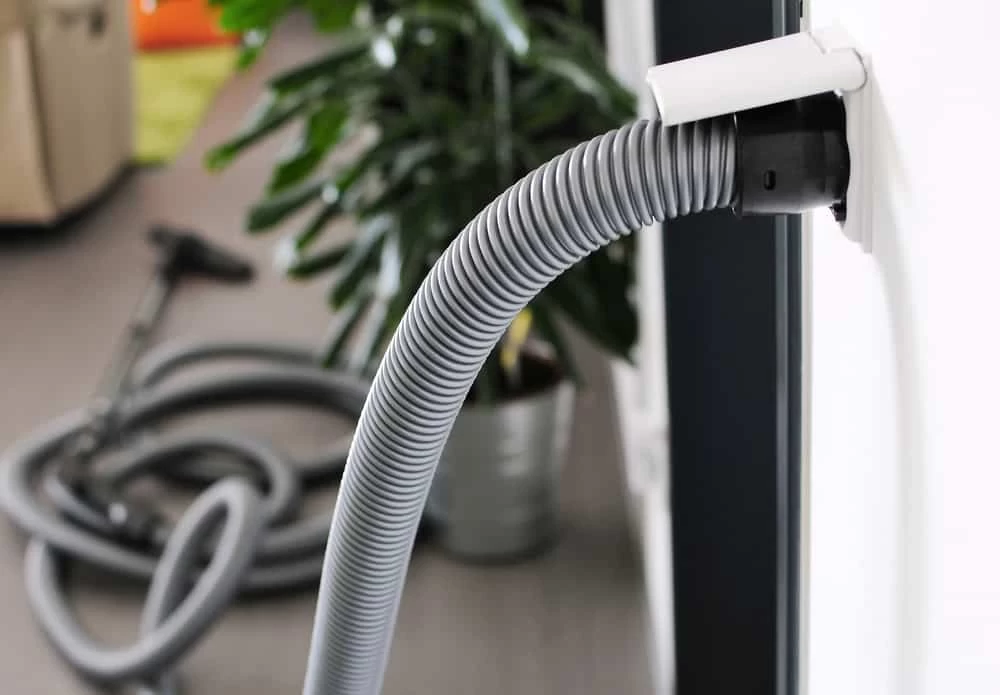
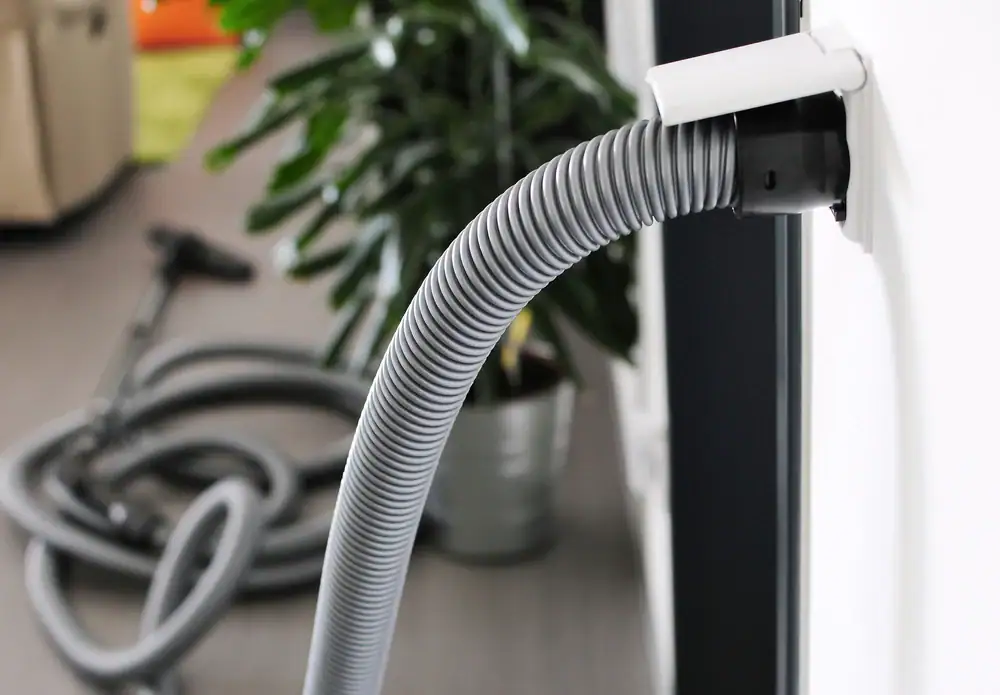
One feature we specialize in that’s worth knowing about is Hide-A-Hose — a retractable hose system that disappears entirely into the wall after use. It’s a genuine quality-of-life upgrade, but it does require a motor with adequate power to maintain suction through the extended pipe network. If Hide-A-Hose is something you want, the motor specification needs to account for it from the start — it’s not something you can just add to any existing unit.
Does a Dual-Motor Unit Perform Better Than a Single Large Motor?
It’s a reasonable assumption: two motors must outperform one. But it’s not always true, and it’s the kind of claim worth examining before you spend more money on it.
Some dual-motor central vacuum units use two smaller, lower-performance motors running on standard 110–120 volt power. In those cases, you’d often get better real-world performance from a single large Tangential Bypass motor — a 7.2-inch unit, for example — than from two underpowered motors working in tandem. The combined airwatt spec might look impressive on paper, but the actual cleaning performance can fall short of what a well-specified single-motor unit delivers.
True high-performance dual-motor systems run on 220–240 volts and use two full-size motors. That configuration is designed for very large installations — homes over 7,000 square feet — where a single motor genuinely can’t cover the distance. For the vast majority of Nassau County homes, which average under 2,000 square feet, a dual-motor system is unnecessary and the marketing around it can be misleading.
The question to ask when comparing units isn’t “how many motors does it have?” It’s “what size motor, what type, and what voltage does it run on?” Those three details tell you far more about what you’re actually buying. We’ve seen plenty of Nassau County homeowners come to us after buying a dual-motor unit online based on the spec sheet, only to find the suction underwhelming once it was installed. Getting the right single motor — properly sized and correctly installed — almost always outperforms a dual-motor unit that wasn’t designed for the home’s actual layout and usage demands.
How to Choose the Right Central Vacuum Unit for Your Home
The right central vacuum unit isn’t the one with the highest airwatt number or the most motors. It’s the one that’s matched to your home’s square footage, your pipe layout, your usage habits, and — if you want features like Hide-A-Hose — the full demands of your system from inlet to motor.
For most Nassau County homeowners, that means a mid-range Tangential Bypass motor, properly sized inlets, and an installation that works with your home’s existing structure rather than against it. Whether you’re in a 1,500 square foot ranch in Levittown or a two-story colonial in Manhasset, the sizing math is specific and the motor choice matters more than most buyers realize going in.
We offer free consultations where we assess your home and recommend the right system — no pressure, no upsell. Reach out and we’ll walk you through exactly what your Nassau County home needs.