
Summary:
If your central vacuum hose just gave out — or you’ve been quietly frustrated with it for years — you’re probably assuming a replacement is a straightforward swap. Same hose, same length, done. But there’s more to it than that. There are three fundamentally different types of central vacuum hoses, and picking the wrong one means your system either won’t turn on or won’t power the attachments you’re counting on. And if you haven’t heard about retractable in-wall hose systems yet, you might be about to rethink the whole setup. Let’s walk through what you actually need to know.
Built In Vacuum Hose: What Type Do You Actually Have?
The hose is the part of your central vacuum system you interact with every single time you clean. It connects the wall inlet to whatever attachment you’re using — a floor brush, a powerhead, an upholstery tool — and it’s the reason the whole system either feels effortless or feels like a chore.
What most homeowners don’t realize is that not all built in vacuum hoses are wired the same way. The type of hose you need depends on your inlet configuration and what you want the hose to do. Getting this wrong is one of the most common — and most avoidable — mistakes people make when replacing a hose.
Central Vacuum Cleaner Hose Types: Basic, Low-Voltage, and Electric Explained
There are three categories of central vacuum cleaner hose, and each one serves a different purpose.
The most basic type activates suction and nothing else. There’s no wiring inside the hose — it’s a straight mechanical connection between the inlet and your cleaning attachment. This works fine for hard floors and simple tasks, but it means you can’t control the power unit from the hose handle. You turn the system on at the wall inlet and leave it running until you’re done. It’s the most affordable option, but it’s also the most limited.
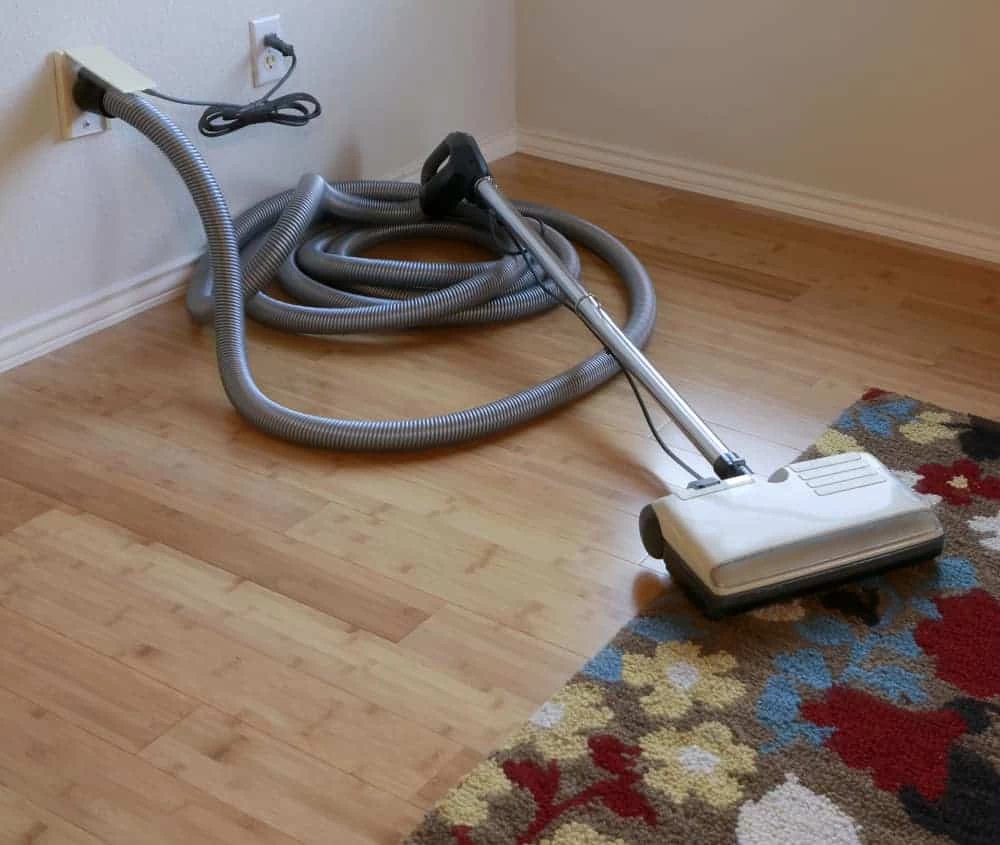
Low-voltage hoses are the most common type in residential homes, and for good reason. They include thin low-voltage wiring that runs through the hose from handle to inlet, which lets you switch the power unit on and off using a button or switch on the handle — no walking back to the inlet every time you want to pause. Most have a 360-degree swivel at the inlet end to prevent kinking, and they’re compatible with non-electric attachments like floor brushes and dusting tools. One important note: low-voltage hoses are not compatible with motorized powerheads. If you want to run an electric carpet brush, you need the third type.
Electric hoses carry both low-voltage wiring and a 110-volt electrical connection to power motorized attachments. That’s what drives the spinning brush roll in a powerhead — the kind that actually agitates carpet fibers for a deep clean. Electric hoses connect to the system in one of two ways: direct-connect, where the electrical connection is built into the inlet, or pigtail, where a short cord plugs into a standard wall outlet nearby. If you have carpet throughout your home and rely on a motorized brush, this is the hose type you need. It’s the most capable and the most expensive, but it’s also the only one that fully unlocks the cleaning power of a central vacuum system on carpeted floors.
Knowing which type you have — and which type your system supports — matters before you buy anything.
How Long Is a Standard Central Vacuum Hose, and Is It Long Enough?
Standard central vacuum hoses run 30 to 35 feet in length. That’s enough to cover roughly 700 to 1,000 square feet from a single inlet — which works well in smaller rooms or homes with inlets placed in central hallway locations, as recommended.
But length isn’t always the problem people think it is. A 30-foot hose draped through a doorway, looped around a furniture leg, and stretched toward a far corner of a room is technically “long enough” — it’s just not comfortable to use. That’s the part that gets overlooked. The hose doesn’t just need to reach; it needs to reach without making you fight it the whole time.
This is also where inlet placement matters enormously. If your inlets were installed behind doors, in awkward corners, or in locations that made sense during construction but don’t match how you actually move through the house, no hose length is going to fix that. It’s a layout problem, not a hose problem — and it’s one of the things we assess when Nassau County, NY homeowners call us about a system that feels harder to use than it should be.
There’s also the question of what happens when the hose isn’t in use. Standard hoses need to be stored somewhere — a closet, a utility room, a hook on the wall. That’s 30-plus feet of hose to coil, carry, and put away every time you clean. For a lot of people, that friction is exactly why the vacuum doesn’t come out as often as it should. And that’s the real cost: a system that’s technically capable but practically underused because the hose is a hassle.
Retractable Central Vacuum Hose Systems: What Hide-A-Hose Actually Does
The Hide-A-Hose retractable system takes a fundamentally different approach to the hose problem. Instead of storing the hose in a closet and carrying it to each inlet, the hose lives inside the wall — coiled within the existing 2-inch PVC vacuum tubing — and you simply pull it out when you need it. When you’re done, the system uses its own suction to draw the hose back in. No winding, no carrying, no storage.
This isn’t a gimmick. It’s the reason the biggest complaint about central vacuuming — managing the hose — goes away entirely for homeowners who make the switch.
How Much More Can a Retractable Hose Cover Compared to a Standard Hose?
The coverage difference is significant. A standard 30-foot hose covers approximately 700 to 1,000 square feet per inlet. A Hide-A-Hose retractable system covers approximately 2,300 square feet per inlet — more than double the reach, which means fewer inlets needed to cover the same home.
That matters for a few reasons. Fewer inlets means fewer wall penetrations during installation, which is a real concern in Nassau County’s older homes where finished walls and plaster interiors make every cut a careful decision. It also means a more streamlined system overall — less tubing to run, fewer valves to install, and a cleaner result.
The RapidFlex hose, one of the Hide-A-Hose product options, is larger in diameter than a standard hose, which increases airflow by as much as 30 percent. So the upgrade isn’t just about convenience — it’s also about cleaning performance. More suction reaching more of your home with less effort on your end.
The Hide-A-Hose locking mechanism is worth understanding too. It maintains full suction at any length of hose, which means whether you’ve pulled out 10 feet or 45 feet, the system is performing at the same level. That’s not the case with every retractable system on the market, and it’s one of the technical reasons this particular product has become the standard we work with.
Retractable hose systems are available in lengths of 30, 40, and 50 feet depending on your home’s layout and inlet placement. There’s also a Mini Hide-A-Hose designed for utility spaces — garages, laundry rooms, mudrooms — where a full-length system isn’t necessary but the convenience of in-wall storage still makes sense.
Can a Retractable Central Vacuum Hose Be Installed in an Existing Nassau County Home?
This is the question we hear most often, and the answer surprises a lot of people: yes, in most cases.
Hide-A-Hose does not require a new power unit. It can be retrofitted into an existing central vacuum system, using the existing tubing infrastructure in many situations. What it does require is access to route the hose tubing — and this is where Nassau County homes actually tend to work in your favor.
The post-war housing stock that makes up the majority of Nassau County’s single-family homes — the neighborhoods built out through the late 1940s, 1950s, and 1960s — typically includes full basements and accessible attic space. Those two access points are exactly what a retractable hose installation relies on. Upper-floor inlets route through attic space; main-level inlets route through the basement or crawl space. The same structural features that feel like quirks of older Long Island construction are actually ideal conditions for this type of installation.
There is one layout consideration worth knowing about upfront. The hose tubing needs to travel on a single plane — it can run horizontally through one floor or drop vertically between levels, but it can’t do both in the same run. That’s why a professional assessment of your home’s layout matters before installation. We’ve worked through enough Nassau County homes to know how to read a floor plan and identify where retractable hose runs are feasible and where a different approach makes more sense.
We’ve also heard the concern about installation disrupting finished interiors — particularly from homeowners who’ve recently renovated. It’s a legitimate worry, and it’s one we take seriously. Our approach is to route through existing access points whenever possible, minimizing wall penetration and protecting the work you’ve already done. That’s not something you can count on from a general contractor who occasionally installs central vacuum systems. It comes from doing this specifically, repeatedly, in homes exactly like yours.
If you’re unsure whether your home is a good candidate for a retractable system, a free consultation is the right first step. We can assess your layout, your existing system if you have one, and give you a straight answer about what’s possible — without any obligation to move forward.
Which Central Vacuum System Hose Is Right for Your Nassau County Home?
The short version: it depends on your system, your home’s layout, and how you actually use your vacuum. If you’re replacing a worn-out hose with the same type, make sure you’ve confirmed the inlet compatibility and electrical configuration before you order anything. The wrong hose is a frustrating and avoidable mistake.
If you’re open to reconsidering the whole hose experience — especially if you’ve been quietly annoyed at how cumbersome your current setup is — a retractable system is worth a serious look. The coverage improvement, the airflow gain, and the sheer convenience of a hose that puts itself away are meaningful upgrades, not marketing language.
We’ve spent over two decades installing, repairing, and upgrading central vacuum systems across Nassau County, NY and the rest of Long Island, and central vacuum is all we do. If you have questions about hose types, system compatibility, or whether a retractable system makes sense for your specific home, reach out to DuraVac Central Vacuum Specialists, Inc. — we’re easy to get on the phone, and the first conversation costs you nothing.