
Summary:
If you live in a Cape Cod, ranch, or split-level in Nassau County, there’s a good chance your home was built somewhere between 1947 and 1975. That puts it squarely in the era of post-war suburban construction — homes that were built fast, built affordably, and built without a lot of the features we take for granted today. Central vacuum systems weren’t on the list. But that doesn’t mean you can’t have one now.
We’ve spent years helping Nassau County homeowners retrofit their post-war homes with built-in vacuum systems, and we’ve learned exactly what works in Levittown, Massapequa, Wantagh, and throughout the region. This guide walks through how built-in vacuum systems work, what installation looks like in older Long Island homes specifically, and what you should know before making any decisions.
What Is a Built-In Vacuum Cleaner and How Does It Actually Work?
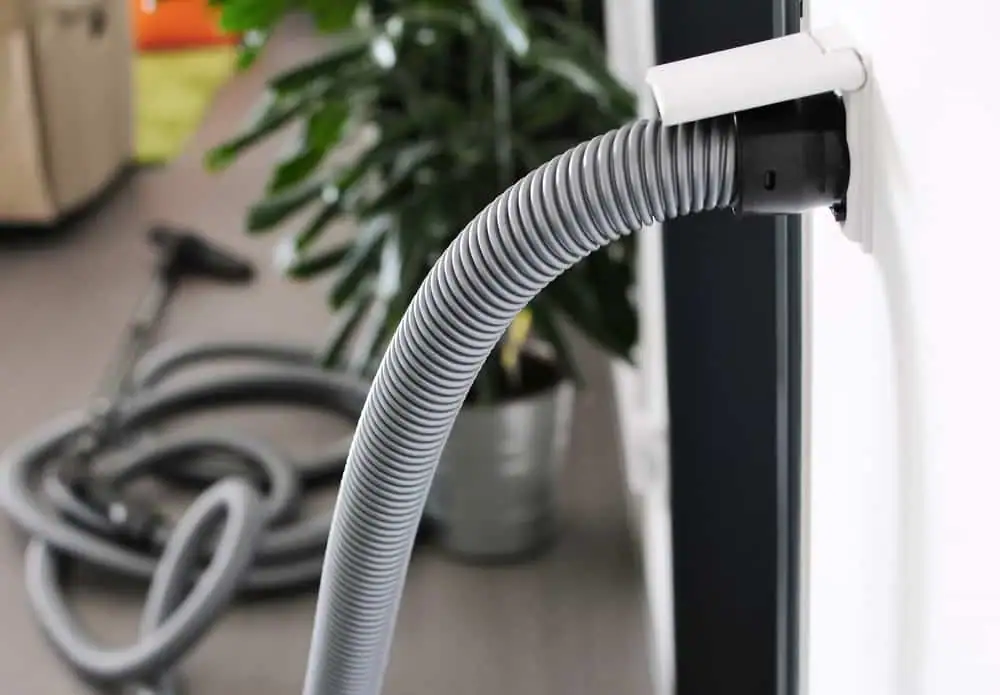
A built-in vacuum cleaner — also called a central vacuum system — is a permanently installed system that routes suction through PVC piping hidden inside your walls, floors, and ceilings. The motor lives in a fixed location, usually a garage, basement, or utility closet. You plug a lightweight hose into an inlet valve on the wall, and the suction pulls dirt and debris through the piping and into a collection canister near the power unit.
There’s no machine to lug around. No cord to manage. No exhaust blowing back into the room you just cleaned. The dirt leaves your living space entirely — which is a meaningful difference from portable vacuums, not a minor one.

How Powerful Is a Central Vacuum Compared to a Regular Vacuum?
The short answer: significantly more powerful. Because the motor doesn’t need to be portable, it can be much larger than anything built into a handheld or upright unit. Central vacuum systems are commonly cited as up to five times more powerful than standard portable vacuums — and that gap doesn’t shrink over time the way a portable motor’s performance often does.
For Nassau County homeowners, this matters in a specific way. A lot of post-war homes — particularly those built in the late 1940s and 1950s — have original or near-original wall cavities, older insulation materials, and flooring that’s been through decades of use. Aging construction materials shed particulates at higher rates than modern ones. Older carpets trap more. The gap between “cleaned” and “actually clean” is wider in a 70-year-old home than it is in new construction, and a more powerful system closes that gap in a way a portable vacuum simply can’t.
There’s also the air quality angle, which is worth taking seriously. The EPA has documented that indoor air can be two to five times more polluted than outdoor air — and in some cases more than a hundred times worse. A portable vacuum recirculates its exhaust air through the room you’re cleaning, pushing fine particles back into the space. A central vacuum exhausts everything outside the living area, the same way a dryer vents to the exterior. In a sealed older home, that difference is real and measurable.
A University of California study found that central vacuum use can reduce allergy and asthma symptoms by up to 52%. For Nassau County residents dealing with Long Island’s high pollen seasons — tree pollen in spring, ragweed in fall — that’s not a minor footnote. The power advantage also means fewer passes, less time cleaning, and better results on pet hair and dander. If you have dogs or cats in a post-war home with older flooring, you already know how quickly that accumulates. A central vacuum handles it more efficiently than most portable units, including premium ones.
How Long Does a Central Vacuum System Last?
This is one of the more underappreciated aspects of the decision. Central vacuum systems are built for long-term installation — manufacturers design them with lifespans of approximately 20 to 25 years. That’s not a marketing claim; it reflects the reality that the motor is stationary, protected from the bumps and drops a portable vacuum takes, and sized appropriately for the load it handles.
When you spread the cost of a central vacuum system over two decades of use, the math looks very different than it does on day one. Most households replace a portable vacuum every five to seven years — sometimes more often if it’s used heavily or if pet hair and debris wear the motor down faster. A central vacuum outlasts three or four portable vacuum cycles.
For Nassau County homeowners who’ve been in their homes for a long time — and a lot of people in Levittown, East Meadow, Massapequa, and Wantagh have been — this is a home improvement with a genuinely long return window. It’s also a feature that registers with buyers if you ever sell. In a Nassau County real estate market where homes are valued well above state and national medians, a central vacuum is a legitimate differentiator that can be listed as a home amenity.
The maintenance side is straightforward. The collection canister needs to be emptied periodically — far less often than a portable vacuum’s bag or bin — and filters need occasional cleaning or replacement depending on the system type. Routine service keeps the motor running at full capacity. With proper care, a well-installed system is genuinely a once-in-a-generation purchase.
Central Vac Wall Outlets in Post-War Nassau County Homes: What Installation Actually Involves
This is where most Nassau County homeowners get stuck. The question isn’t really “do I want a central vacuum?” — it’s “can I actually get one in my house?” If your home was built before 1980 and doesn’t have a basement, or has limited wall access, the assumption is often that installation would require tearing things apart.
That assumption is wrong more often than it’s right. Nearly one-third of all central vacuum systems installed in the United States go into existing homes — not new construction. The routing method is different, but the result is the same. We work with your home’s existing structure, not against it.
Central Vacuum Inlet Placement: How It Works in Cape Cods, Ranches, and Split-Levels
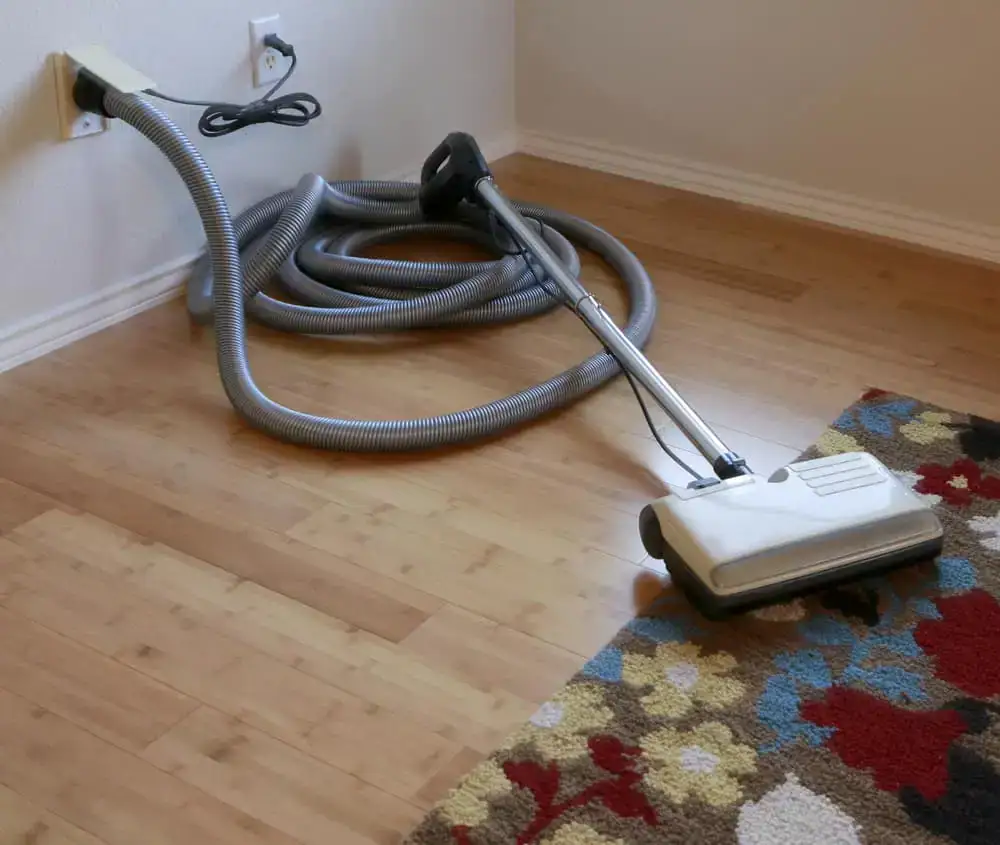
A central vacuum inlet — the wall outlet you plug the hose into — is typically a small, flush-mounted valve that sits in the baseboard or lower wall. When the hose connects, it triggers the system to activate. When you disconnect, it shuts off. The inlet itself is clean, unobtrusive, and takes up no more wall space than an electrical outlet.
In a standard new construction installation, PVC tubing runs through the framing before the walls are closed. In an existing home, the routing strategy depends entirely on the home’s structure. This is where Nassau County’s post-war housing stock creates a specific set of considerations that a general installer might not be familiar with — but that we work with routinely.
The original Levittown Cape Cods, built between 1947 and 1949, were constructed without basements. This was a deliberate decision by Levitt & Sons to accelerate construction and keep costs down — the original homes sold for $6,990 with no money down for veterans. No basement means no easy under-floor routing path. But Cape Cods were also designed with expandable attics, and that attic space is the primary routing path for central vacuum installation in these homes. Tubing runs through the attic and drops down through interior wall cavities to reach inlet locations on each floor. The power unit goes in the garage or a utility closet. It works cleanly, and it’s a method we’ve used in hundreds of Nassau County homes.
Ranch homes — common throughout Hicksville, Seaford, Bethpage, and Plainview — present a similar picture. Single-story, often on slab foundations, with attic access as the primary routing path. The advantage of a ranch is that everything is on one level, which simplifies inlet placement and reduces the total pipe run needed. The power unit typically goes in the garage.
Split-levels, which became popular across Nassau County through the 1950s and 1960s, are actually well-suited to central vacuum installation. The different floor levels create natural opportunities for power unit placement in lower-level utility areas, and the partial basements or lower-level rooms common in split-levels give installers more routing flexibility than a slab-foundation home. Colonials from the 1960s and 1970s — two-story homes, often with full basements — are the most straightforward of all.
Each home type has a workable solution. The approach isn’t one-size-fits-all, which is exactly why custom system design matters. A company that installs the same way in every home regardless of structure will run into problems. We’ve spent years working specifically in Nassau County’s post-war housing stock, so we know what to expect before we walk in the door.
What About the Hose? How Hide-A-Hose Changes the Experience in Older Homes
Even homeowners who are sold on central vacuums often have one lingering concern: the hose. A standard central vacuum hose runs 25 to 30 feet, which is long enough to reach most areas from a single inlet. But it’s also long enough to be genuinely awkward to store and carry between rooms. In a modest post-war home — original Levittown Cape Cods started at around 750 square feet — a 30-foot hose doesn’t have an obvious home when it’s not in use.
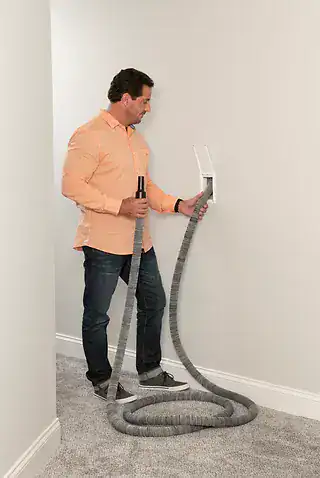
The Hide-A-Hose system solves this in a way that’s worth understanding. Instead of a traditional hose that you store in a closet or hang on a hook, the Hide-A-Hose retracts automatically into the wall piping after use. You pull the hose out from the inlet to the length you need, clean, and when you’re done, the system’s suction draws it back inside the wall. There’s nothing to coil, nothing to store, and nothing to trip over.
For older Nassau County homes — where storage space is often limited and closets were designed for a different era — this is a practical solution to a real problem. It’s not a luxury feature for large homes; it’s arguably more useful in smaller ones. We install Hide-A-Hose systems throughout Nassau and Suffolk County, and it’s become one of the most common requests we get from homeowners in post-war neighborhoods.
The retractable system also changes how people actually use their central vacuum. When the hose lives in the wall, you’re more likely to grab it for a quick cleanup rather than deciding it’s not worth the effort of getting it out and putting it away. That shift in daily behavior — from “vacuuming as a project” to “vacuuming as a habit” — has a real effect on how clean your home stays between deep-cleaning sessions.
Central vacuum inlets can be placed strategically throughout the home to minimize how far you need to pull the hose in the first place. A well-designed system — one that accounts for your home’s specific layout, traffic patterns, and the rooms that need the most attention — positions inlets so that every area of the home is reachable without stretching the hose to its limit. That’s a design conversation, not just an installation one, and it’s where the planning stage pays off.
Is a Built-In Vacuum System Right for Your Nassau County Home?
If you’ve been on the fence, the most important thing to take away from this is that your home’s age is almost certainly not the barrier you think it is. Nassau County’s post-war homes — the Cape Cods, ranches, split-levels, and colonials that define communities from Levittown to Massapequa to Wantagh — have been successfully retrofitted with central vacuum systems for decades. The routing strategies exist. The technology has kept pace. And the results are meaningfully better than what a portable vacuum delivers, particularly in an older home where air quality and cleaning efficiency matter most.
Whether your main concern is allergies, the physical effort of cleaning a multi-story home, pet hair, or simply wanting a system that lasts — a built-in vacuum is worth a real conversation, not just a passing thought. DuraVac, Inc. specializes exclusively in central vacuum systems, and we’ve been doing this work in Nassau and Suffolk County long enough to know every home type, every routing challenge, and every question you’re likely to have. Reach out for a free consultation and we’ll give you a straight answer about what’s possible in your specific home.