Summary:
You’ve already done the research on central vacuum systems. You know they outperform portable vacuums, you know they’re better for allergies, and you’ve decided this is the right upgrade for your home. Now you’re facing a question that almost nobody answers well: retractable hose or standard?
It sounds like a small detail. It isn’t. The hose system you choose affects how you clean every single day, what the installation looks like in your specific home, and whether you’ll still be happy with the setup five years from now. Here’s the honest comparison — no spin, no manufacturer talking points — just what you actually need to know.
How a Central Vacuum System Hose Actually Works
Every central vacuum system has the same basic anatomy: a power unit mounted in a garage, basement, or utility room, connected to a network of PVC pipe running through the walls and floors, with inlet valves placed at strategic points throughout the home. The hose is what connects you to that system — and that’s where the two approaches diverge.
With a standard setup, you plug a 30-to-35-foot hose into the nearest inlet, clean what you can reach, then unplug and move to the next inlet. It works well. The hose stores in a closet or on a hook when you’re done.
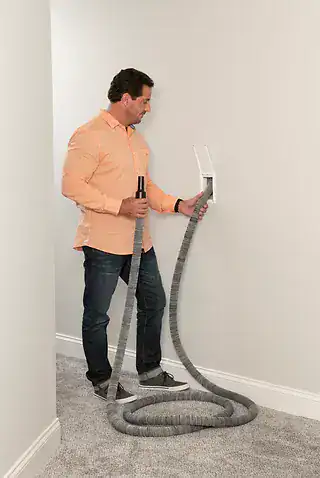
With a retractable system, the hose lives inside the wall. You pull it out from the inlet, clean, and let go — suction pulls it back in automatically. Nothing to carry, nothing to store.
What Is a Central Vacuum Cleaner Hose and Which Type Do You Have?
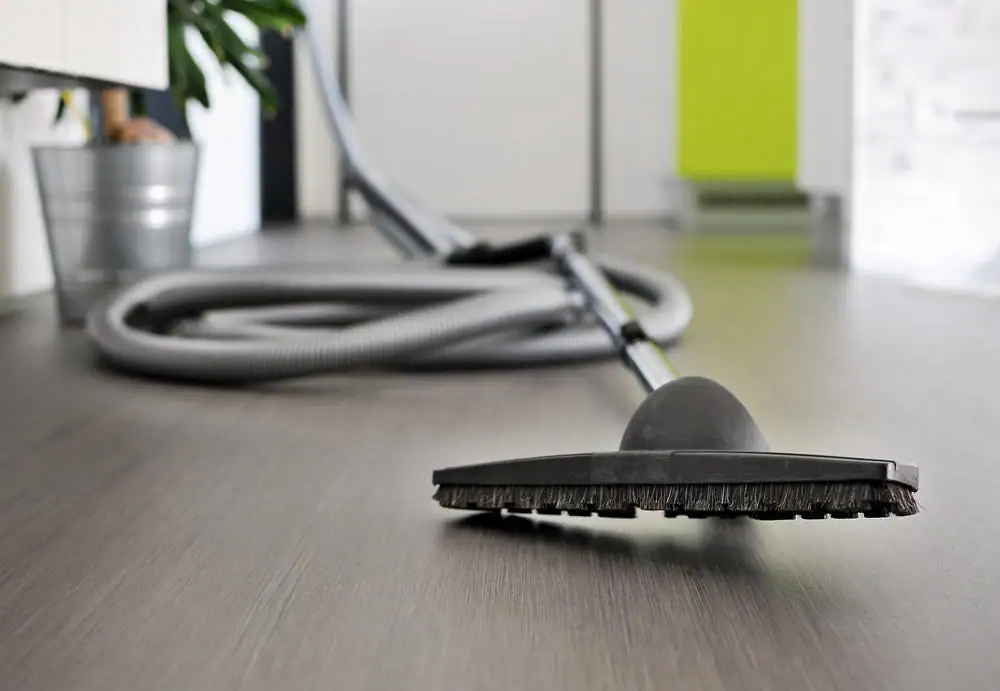
Standard central vacuum hoses come in two forms. The simpler version is a low-voltage air hose — lightweight, straightforward, and compatible with most floor tools and brush heads. The more capable version is an electrified hose, which carries electrical current from the inlet valve down to a motorized carpet brush. If you’ve ever used a central vacuum with a power head that spins on its own, that’s an electrified hose doing the work.
Both types are effective. The main limitation they share is that you’re responsible for the hose at all times — carrying it between rooms, coiling it up after use, and finding somewhere to put it when you’re not cleaning.
In a smaller home, that’s a minor inconvenience. In a two-story Cape Cod or a split-level across Nassau County, NY, it starts to add friction to every cleaning session.
Standard hoses typically reach 30 to 35 feet from the inlet. That’s enough to cover a room or two, but in a home with multiple floors and a traditional layout, you’ll need several inlets — usually two to four per floor — to avoid constantly moving the hose. Each inlet adds to the overall installation cost, so the “cheaper” system isn’t always cheaper when you account for full coverage.
One more thing that often surprises people: the hose doesn’t determine your suction power. That’s entirely a function of the power unit. A properly specified unit paired with either hose type delivers full central vacuum performance. If someone tells you a retractable hose weakens suction, they’re confusing the hose with an undersized motor.
How Does a Hide-A-Hose Retractable System Work?
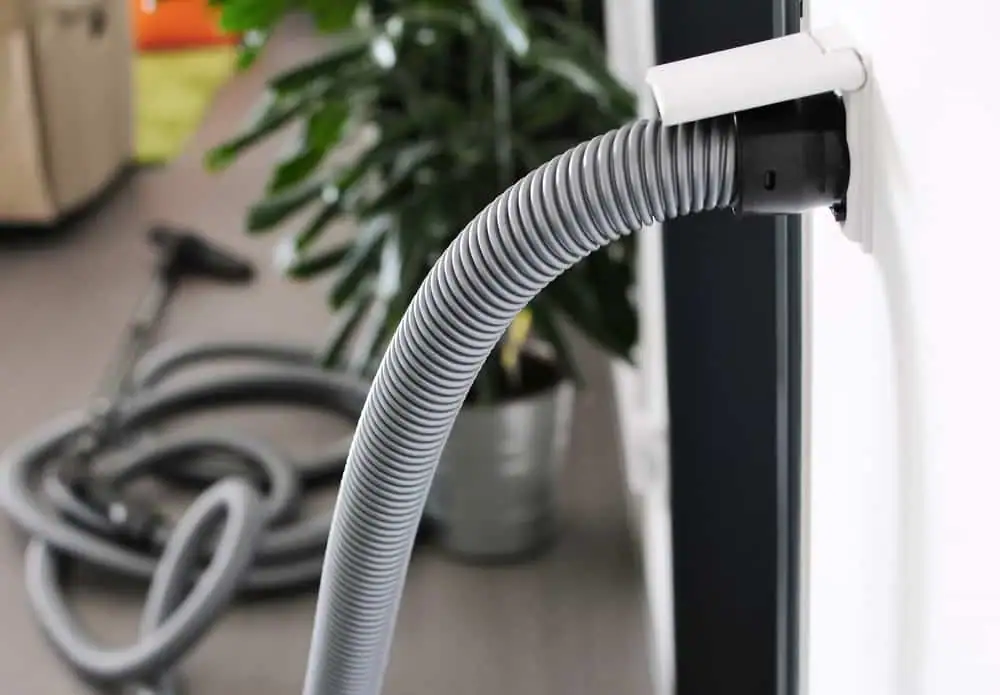
Hide-A-Hose is the leading retractable central vacuum hose system on the market, and it works differently than most people expect. There’s no spring mechanism, no motorized reel, and no moving parts inside your wall. The hose retracts using the vacuum’s own suction — when you’re done cleaning, you let the hose go slack near the inlet and the airflow pulls it back through the pipe.
The hose itself lives coiled inside a dedicated section of 2-inch PVC pipe that runs from the inlet back to the main line. It’s available in 40-, 50-, and 60-foot lengths. A single 50-foot hose can cover approximately 2,300 square feet from one inlet point — which means that for the average Nassau County, NY single-family home, you may only need one inlet per floor to achieve complete coverage.
Fewer inlets means a cleaner installation and, in many cases, a cost difference that narrows the gap between the two system types.
Because there are no mechanical components inside the wall, there’s nothing in the wall to break. The hose itself can wear over time and be replaced if needed, but the infrastructure behind it — the pipe, the fittings, the inlet valve — is the same durable PVC used in any standard central vacuum installation. The system is also compatible with existing central vacuum power units in many cases, which matters if you’re upgrading rather than starting from scratch.
One planning note that’s specific to retractable systems: the hose pipe needs to travel on a single plane. It can’t make a transition from vertical to horizontal mid-run without risking retraction issues. This is exactly the kind of detail that separates an experienced installer from someone who’s figured it out from a YouTube video. The routing has to be thought through before anything is cut.
Retractable Hose Vacuum vs. Standard: Which Is Right for Your Nassau County Home?
This is where the local context matters. Nassau County, NY’s median home was built in 1955. We’re talking about Cape Cods, ranch homes, and split-levels — finished walls, tight basement clearances, and no central vacuum infrastructure to begin with. Every installation we do here is a retrofit, and the hose system you choose affects how that retrofit gets planned and executed.
Both systems can be installed in existing homes. But they’re not identical in complexity, and the right answer genuinely depends on your specific layout, your cleaning habits, and what you want out of the system long-term.
When Hide-A-Hose Is the Smarter Upgrade for Your Home

Hide-A-Hose earns its premium in homes where the daily friction of hose management is real. If you’re cleaning a two-story home, carrying a 30-foot hose up and down stairs is a legitimate inconvenience — not a minor one. If you have kids who won’t vacuum because it’s too much effort, a system where you pull a handle and start cleaning is genuinely different.
One of our customers put it plainly: once they switched, even the kids wanted to vacuum. That’s not marketing — that’s what happens when you remove every barrier between the thought and the action.
For Nassau County, NY homeowners dealing with Long Island’s allergy seasons — ragweed peaks in the fall, tree and grass pollen in the spring — the speed and ease of a retractable system means you’re more likely to vacuum frequently, which directly affects how much allergen accumulates in your home. A UC Davis School of Medicine study found that switching from a portable vacuum to a central vacuum system reduced allergy symptoms by up to 61%. That improvement compounds when the system is easy enough to use every day.
Hide-A-Hose also makes sense if you’re already planning a renovation. When walls are open — during a kitchen remodel, a bathroom gut, or any project that exposes framing — routing the additional pipe for a retractable system becomes significantly simpler. Nassau County, NY’s renovation culture, driven partly by low housing inventory and homeowners choosing to improve rather than move, creates a natural window for this kind of installation. If you’re already disrupting walls for another project, adding a retractable hose run at the same time is the most cost-effective moment to do it.
The 20-to-30-year lifespan of a central vacuum system also changes the math on the upfront cost difference. Spread over 25 years of daily use, the incremental cost of a retractable system is genuinely small — far less than replacing a portable vacuum every five to seven years.
When a Standard Central Vacuum Hose Is the Right Call
Honest answer: not every home needs Hide-A-Hose, and not every homeowner wants it. If cost is the primary concern and you’re comfortable managing a hose — carrying it between rooms, storing it in a closet — a standard central vacuum system delivers the same air quality benefits, the same suction performance, and the same allergen reduction at a lower upfront cost. The core technology is identical. Both systems exhaust all air and particles outside the living space, unlike portable vacuums that recirculate filtered air back into the room you’re cleaning.
Standard systems also remain the practical choice in homes where the layout makes retractable pipe routing genuinely difficult. Some Nassau County, NY homes — particularly those with finished basements, no accessible attic space, and interior walls with limited cavity access — present routing challenges that add cost and complexity to a Hide-A-Hose installation. In those cases, a well-planned standard system with properly placed inlets can cover the home effectively without the additional infrastructure.
If you’re a lighter user — cleaning once a week in a smaller home, or primarily using the central vacuum for spot cleaning and pet hair — the daily convenience argument for retractable is less compelling. The system still works beautifully, but the premium may not be justified by your actual usage pattern.
This is why we offer a free consultation before recommending anything. We’ve been installing central vacuum systems in Nassau County, NY homes for decades, and we’ve seen enough 1950s Cape Cods and 1960s split-levels to know that the right answer isn’t the same for every address. A quick conversation about your home’s layout, your cleaning habits, and your priorities tells us far more than any general comparison can.
Which Built-In Vacuum Hose System Should You Choose?
Here’s the short version: if you want the most convenient central vacuum experience and your home’s layout supports it, Hide-A-Hose is genuinely worth the upgrade. If you want the core benefits of a built-in system at a lower upfront cost and you don’t mind managing a hose, a standard system delivers everything that matters most — better air quality, real suction power, and a dramatic reduction in the allergens circulating through your home.
What neither system can do is install itself well in a 70-year-old Nassau County, NY home without someone who knows what they’re doing. The pipe routing, the inlet placement, the power unit sizing — these decisions have long-term consequences, and getting them right the first time is the whole game.
If you’re ready to figure out which system fits your home, DuraVac, Inc. offers free consultations and answers the phone without putting you through an automated menu. Call us at 516-822-3060 and let’s talk through what your home actually needs.